Senior Constable First Class (SC1C) Sonia Wellings (pictured above with police horse Encounter) says being a mounted police officer is the best job in the world. She shares in her own words what she loves about the job, her journey to becoming a mounted police officer and why horses are relevant in modern-day policing.
A childhood dream
I joined the South Australia Police Force in February 2001. I grew up dreaming of being a police officer and my auntie was also an officer. Although horse riding has been a passion of mine since I was 10 years old, I always knew that I wanted to become a police officer first as I wanted to get good at being an officer and then hoped to transition into the mounted operations. I became a mounted operations officer five years ago and it's seriously the best job ever. I love it.
While every day is different, there is also a pattern to our days. It really depends on which shift you are working, but every shift starts with parade (a morning briefing) where we are allocated our duties for the day, which always includes training. However, at any moment we can be called upon to assist in a variety of tasks.
The role of mounted horses in modern-day policing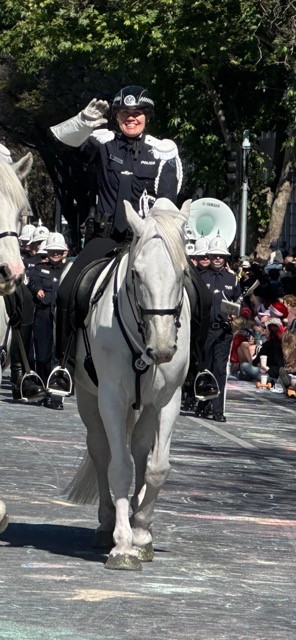
We are police officers foremost, whose mode of transport is horses. When I first started as a police officer, I was on general patrols at Holden Hill and then Golden Grove before heading regional to Port Pirie and Kadina. I was then transitioned to prosecutions, so working in the courts, before I moved back to Adelaide and worked in Port Adelaide before I finally made the jump to mounted operations.
The job of a mounted police officer covers four main areas: operational, ceremonial (pictured right), search and rescue, and public order.
When we perform operational duties, it’s mainly patrolling in the city, specifically patrolling Hindley St, where most South Australians may see us on duty.
A smaller part, but important to me, is ceremonial tasks. We can be called upon to lead parades, guards of honour and we also took over the role of Governor escorts from the Light Horse.
During search and rescue, our skillset becomes invaluable as we are able to cover more area than those on foot, specifically on rough terrain, and can even be more useful than drones because we can get under canopies of trees where they can’t access.
For public order, we mainly manage crowds at events and protests. As we have a greater view, due to being on horseback, we usually see things before an officer on foot can.
Preparing the horses for duty
We have 32 horses in the mounted operations, all which are white or grey, at least 16 hands high and calm tempered. The horses are sourced from all around Australia from auctions, advertisements and word of mouth.
The main part of our job is training our horses. We do training at the barracks but also perform exposure therapy by taking the horses into quiet Adelaide suburbs and then slowly move them to the city, where they predominately will work. They are animals at the end of the day, so we don’t have a definitive timeline for them to complete their training and some horses we have aren't suitable for the job and that’s also completely OK.
Part of our training is learning how to ride any horse at any time because we can be called up very quickly. However, I have one or two horses that I mainly ride with as you build a bond with them and a rapport, which is really special as you can learn how to do certain tricks and habits with them. When the horses begin training, we do like to keep it to one or two riders for consistency and because they are still learning it helps them not get too confused.
We were recently called upon to investigate an area near Marla, which was super interesting. I felt like a pioneer on horseback scaling such rocky terrain and surveying creek beds.
An occupation of tradition
Ceremonial duties are prepared for through our training. Sometimes we have to hold a lance, and hold four reins instead of two, so there is plenty of practice with that. It can also take up to three days to prepare the horses' coats for these occasions as they can get dirty very quickly. There is plenty of washing and cleaning and it might be interesting to know that we even use purple shampoo on their coats to make them nice and bright. Our ceremonial uniform has evolved over time but is based on tradition and features fancy epaulettes, lanyards and white gloves.
When we do Governor escorts, we also carry real swords, and the horses have ceremonial dressings. I think we look awesome!
What the role entails
To become a mounted police officer, you need to be off your probation period, have a minimum rider standard and the ability to a control a horse while riding. You don’t need to have a horse background because we provide all your training.
However, to be successful I believe it's the things you can’t teach that are important. You need to be resilient as you're completely exposed to the elements. There is no aircon or work from home on the back of a horse, and it can be tiring being outside for long periods of time. Also being able to take initiative, and having the ability to communicate effectively with others so you can help the team you’re working with understand how best they can utilise their skills.
 Honour and privilege
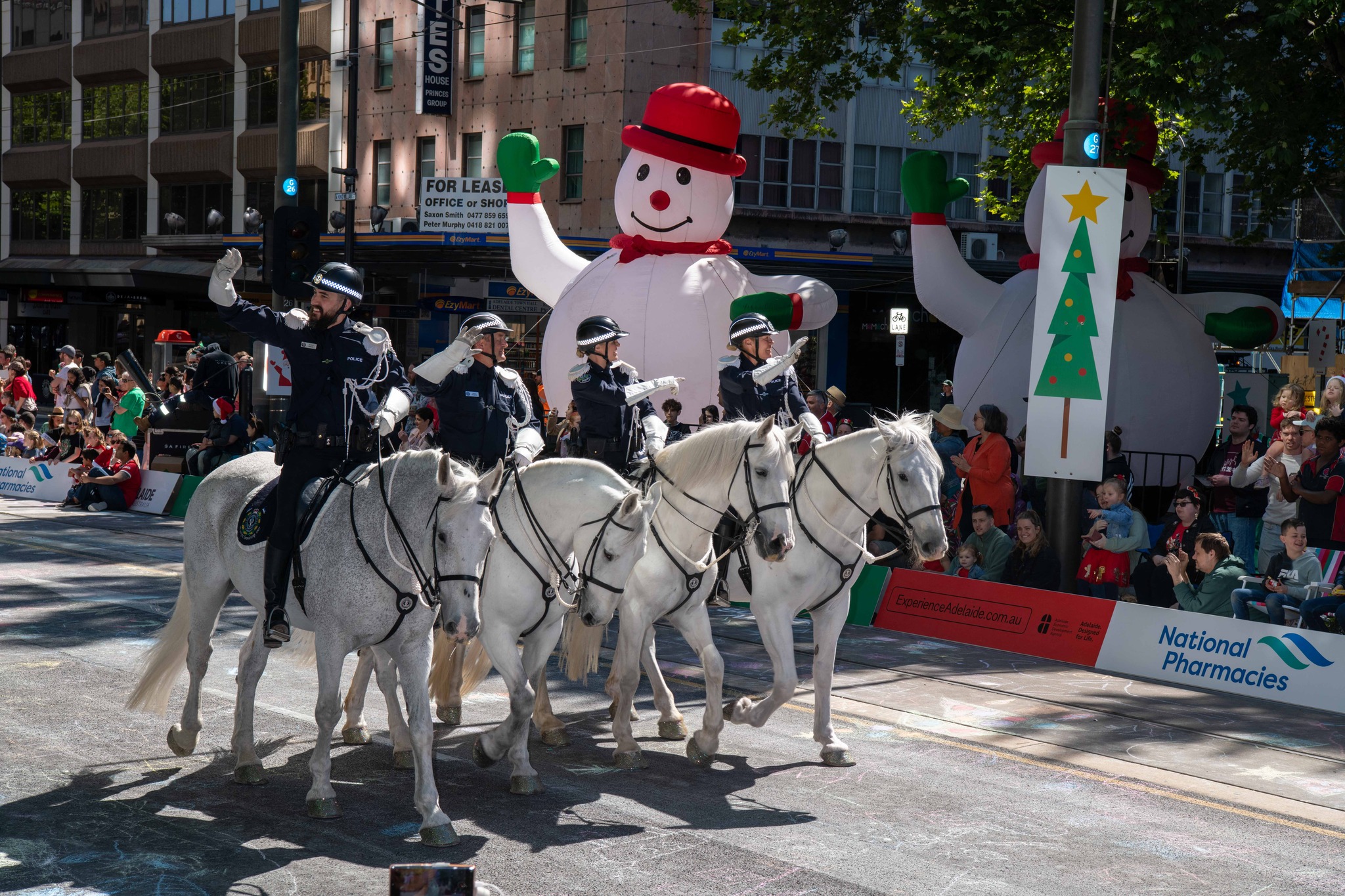
Last year I was lucky enough to participate in my second National Pharmacies Christmas Pageant (pictured left), where I was one of the four officers who were leading the pageant.
For me, leading the Anzac Day parade was both a huge honour and privilege as well as being involved in the guard of honour at the police funeral for Brevet Sergeant Jason Christopher Doig last year (pictured below).
Other key moments were riding down Hindley St on a Saturday night for the first time and when I rode on a horse I had trained, and I was simply bursting with pride. He was perfect!
August 1st is all thoroughbred horses' birthday. I have previously made a special birthday cake for them consisting of rolled oats, molasses and shredded carrots and apple mixed together with carrot sticks for candles.
Future for our police horses
When I reflect on being questioned if horses are relevant to policing in today's world, I think our skills and presence is important.
We create a sense of calm and reassurance. We actively encourage all South Australians to come up and ask if they can pat the horses. It's one of my favourite parts of the job, seeing the public interact with the horses.
However, sometimes it might not be appropriate because at the end of the day they are working animals, and we may need to focus on a task at hand. I feel terrible about saying no when approached, but please feel free to always ask.