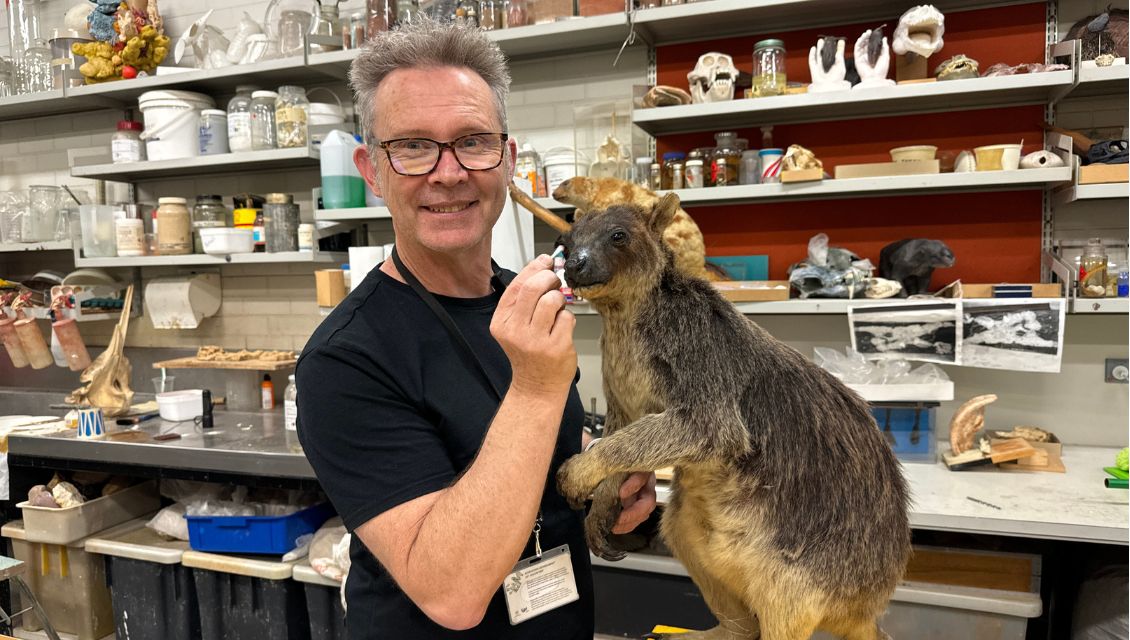
According to South Australian Museum’s taxidermist Jo Bain, there is nothing weird about working with dead animals. In fact, Jo only sees beauty. Read in Jo’s own words what his role at the Museum entails and his infectious passion for animals and their preservation.
A lifelong love of wildlife
Since I was kid, I’ve thought that the most important thing is to look after our wildlife and by using what most people consider garbage – dead things on the side of the road – I am able to communicate how wonderful these animals are.
For me, if you don’t know what animals are out there, you are not going to appreciate them, and if you don’t appreciate them, you are not going to look after them.
It was this love that got me into this field
Originally, I wanted to be vet, but when you are a kid and you learn that inevitably everything dies and there is nothing you can do to stop that, I thought that taxidermy would be an avenue.
My route to the Museum is different to most people's. I started doing work experience here when I was 15 and I’ve been here ever since. I then went through art school and volunteered all the spare time I had at the Museum until I was employed officially in 1988.
My job here is really to communicate the science goals of the Museum to the public. I’m a halfway point between the scientists and the public. Whether its building models, taxidermy, offering advice to the Museum’s scientists about their collections – there really isn’t a typical day.
The man behind one of the Museum’s most popular attractions, the giant squid
That came about after a conversation with the Museum’s then director, Tim Flannery. We had a disused lift shaft that went from the basement to the top floor, after the Museum got new lift carriages which were 5cm larger than the old ones and so it couldn’t go in the old shaft.
So, they built a new lift shaft and were going to board up the old one, so I thought I’ve got an idea. I took it to Tim, and he looked at me suspiciously, took some notes, then came back and said, ‘Let’s do it.’
I built and moulded the entire thing, using new methods of moulding and working off scientific specimens to produce life-like deep sea creatures and the giant squid.
I still get a sense of pride seeing children enjoy the giant squid. I remember being at a dinner party once with a group of people I didn’t know and someone said, 'You know, he’s the guy that built the giant squid' and this woman looked at me and said, 'You bastard – every Saturday morning I have to go there with my son or there will be problems all week'. And it just made me laugh.
One of the joys of this job is to retain that sense of child-like enthusiasm for all those wonderful creatures that are out there – it’s a beautiful thing.
The Ediacara Fossils Gallery
One of my favourite exhibitions would have to be the Ediacara gallery, simply because it is underappreciated and so weird.
One of the many things people don’t know is that South Australia was the cradle for all life on the planet, and that gallery shows those animals, but those creatures are so weird, so alien, they look like nothing that is alive today.
The sourcing of the animals – a practice Jo changed immediately
I predominately source things as roadkill, which never used to be done. We used to have permits to go and shoot animals in national parks, so if you needed an animal, you would just go out and get it. I found that absolutely horrifying, so I put an immediate stop to it as soon as I started working here.
Basically, anything we need, I source now either through roadkill or a network of people that I know who own private zoos or parks, or the Adelaide Zoo itself. The zoo has been one of our greatest sources of specimens over the years. Many of the specimens in the World Mammals Gallery are Adelaide Zoo sourced – it’s a symbiotic relationship really.
To prepare the animals varies - small birds take a day or two to prepare, while larger mammals, like a tree kangaroo, can take a week or longer to prepare. It involves skinning the animal, cleaning and preparing a mount, moulding a body and touching up the skin and finer facial details.
Working on SA’s iconic pink feathered friends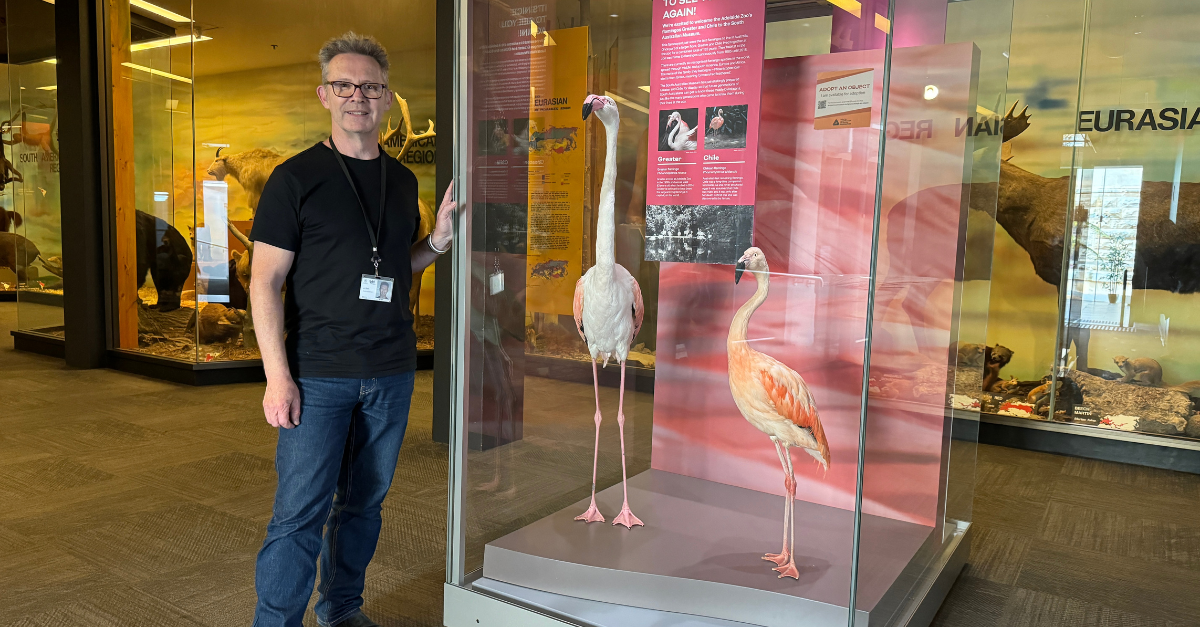
They were the last flamingos in Australia and truly a really iconic animal. But as a job, it was incredibly difficult. One of the things I was conscious of early on, was the flamingo mount.
One of the big problems with birds is the leg wire to be able to stand the bird up, so I devised a method for the flamingos where we removed the legs, moulded them and cast them with an integral metal support so that you didn’t actually see it. This, along with the sheer age of those animals, made it a delicate operation.
Greater was 86 when he died, and that is all due to the exceptional care from the Adelaide Zoo. But it meant that Greater’s skin was extremely fragile, whereas normally bird skin is elastic, but this skin would just snap. It was horrifying. We had to sew a lot of the skin back together. And there are no do-overs, it is the only specimen there is. But it was great to get done, because both Chile and Greater truly deserved a place befitting them and to see them on display is marvellous.
Did you know?
There have been only six generations of taxidermists at the South Australian Museum since 1840 – and each one has taught the next. It means South Australia is the only museum in Australia to have an unbroken line of taxidermist succession.
I have been passed down the knowledge that originated from SA’s first taxidermist, George Beazley, who was brought out to South Australia with the colony in the 1840s, as they recognised that everything was disappearing and needed to preserve it to educate future generations.
You can view many of Jo's amazing works at the South Australian Museum, including at the current Gondwana VR: The Exhibition, open from 9 December - 17 March 2024.