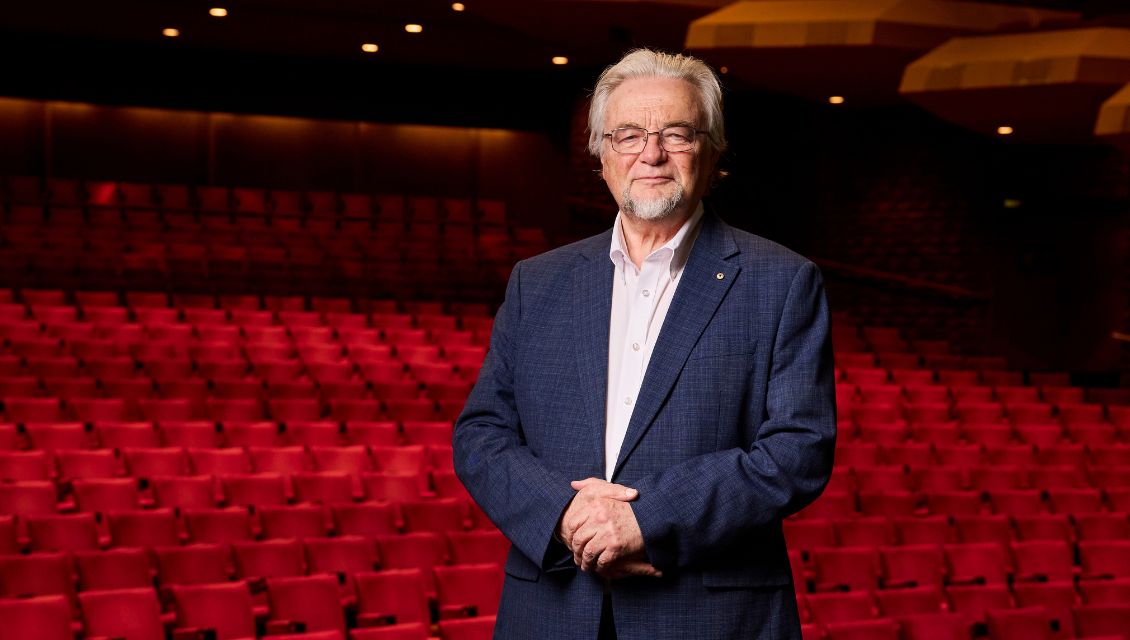
Douglas Gautier’s story – like the story of so many South Australians – begins in post-war Britain.
The Adelaide Festival Centre CEO and Artistic Director was born to good Cockney stock, although he can’t claim to have been born within earshot of the Bow Bells – the traditional definition of an Eastender.
"Well, you see, this is an important point," the jovial Gautier says during a chat in the Dunstan Playhouse.
"The bells were taken away for safekeeping during the war and they weren't restored until 1957.
"I was born before 1957 and I remember saying to my Uncle Bert – who lived right in the East End and was definitely a Cockney – ‘Uncle Bert, you know technically I'm not sure if I'm really a Cockney,’ because the bells had been taken away.
"And he said, ‘you stupid little bleeder, of course you're bloody Cockney!’"
Gautier travelled to Australia by ship in 1957 and thanks to the Suez Crisis, the trip involved making the long haul around the Cape of Good Hope.
The trip was hard on Gautier’s father, who wasn’t in good health, and he died upon arrival in Fremantle.
The now fatherless five-year-old continued on to Adelaide with his grandmother while his mother took care of things in the west.
Despite pleas from family back in London to jump on a plane and go back, Gautier says his mother was adamant that their future was in Australia.
"My mother was a very determined woman, and I definitely think she made the right decision," he says.
Young Gautier leaned into Australian life, going to school at Glenelg Primary and Brighton High, hanging at the beach surfing with mates on the weekend and, eventually, enrolling at Flinders University which – during those days of the Vietnam War – was a hotbed of student activism.
"The humanities faculty included a number of Marxists and Leninists," Gautier recalls.
Among the protests the young student managed to fit in an education, making the most of the first university drama department in Australia, picking the brains of his history professors and generally getting an all-round immersion in the arts.
"I read a lot of books and met a lot of extraordinary people," Gautier says.
"Scott Hicks (Oscar-nominated director) was there, Gale Edwards (acclaimed theatre and opera director) was there, all these interesting people who have gone on to do so well. It was a great time, and I was very lucky."
Of course, Gautier also went on to do well, firstly in the UK and then in Hong Kong.
With his heart set on directing, the Flinders Graduate was "lucky enough" to land a spot in a course at the Bristol Old Vic theatre company where he studied his craft alongside the likes of Daniel Day-Lewis (There Will Be Blood) and Miranda Richardson (The Crying Game), and greats like Alan Rickman and Pete Postlethwaite roamed the halls.
After directing a Sylvia Plath adaptation which actually featured Richardson, Gautier says he felt like he was ready to "take the British theatre world by storm".
"I was offered two jobs," he laughs.
"One was directing a pantomime in Cheltenham, and the other was to go to London to work in the music and arts department at the BBC. It was a pretty easy decision."
Gautier worked mainly on radio, with some TV gigs, but his break came after he asked what he admits was "a stupid question" during an interview with legendary American composer and conductor Leonard Bernstein.
Bernstein made a quip and everyone laughed. Feeling guilty for embarrassing the young interviewer, Bernstein gave Gautier a one-on-one exclusive interview and it was this, he says, that caught the eye of the BBC’s Director General of Radio and Television in Hong Kong.
"He said, ‘I’m looking for someone to go over there and set up a music and arts channel, would you be interested?’
"I said, ‘well, I’m working here’. We were in the BBC canteen at the time, and he said, ‘Look around you – where did all your colleagues go to university?’
"I replied, ‘Oxford and Cambridge’. He said, ‘right, so unless you think you’re Clive James you should try this. Just do it for a year and see how you go’."
Of course he loved it.
It was 1979, and the Asian metropolis was bursting with a can-do attitude, filled to the brim with creative types itching to give virtually anything a go.
Gautier’s first task was to turn the BBC classical musical channel – which was exclusively in English at the time – bilingual (Chinese and English) and greatly expand its potential audience.
Despite the changing times, he still found pockets of resistance.
"One lady said, ‘If Chinese want to listen to classical music then they should learn English’, and I replied, ‘Well, that would have left Beethoven out’," Gautier, pictured right with actor Michelle Yeoh, says.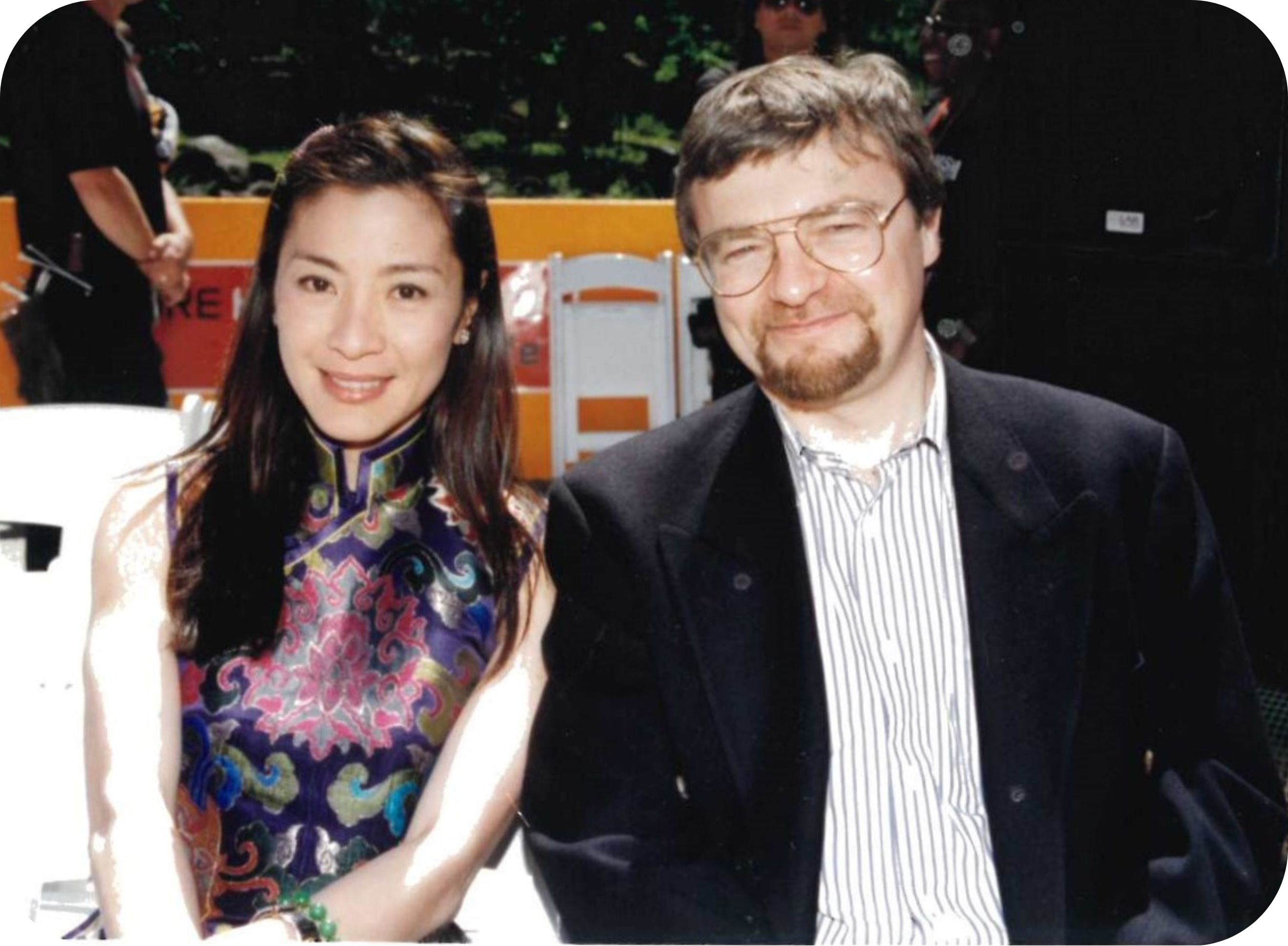
The young Australian tried his hands at many things in Hong Kong but eventually settled in the then-new medium of satellite television which was about to take Asia by storm.
He found himself working for Rupert Murdoch, at the forefront of launching youth station Channel [V] into emerging markets in India, Indonesia, China and Korea, before taking on stints with the Hong Kong Tourist Board and Hong Kong Arts Festival.
Gautier says he learned a lot during his years in Asia, including a deep love for the continent itself, its people and its culture.
It’s a love that would go on to express itself through OzAsia, the popular celebration of all things Asian that Gautier was instrumental in getting up and running when he finally returned to his childhood home to take over the reins at the Festival Centre in 2006.
It was a homecoming on more than one level – Gautier actually appeared in the Festival Centre’s first-ever production in 1973 – and he immediately set out to get more bums on seats through a "program-led" revival.
It worked, and under Gautier’s guidance the centre has had audiences increase to more than one million annually.
Adelaide also became firmly placed on the touring circuit for blockbuster productions and musicals, including Disney Theatrical Group’s debut in Adelaide with Aladdin, and Gautier led the spectacular redevelopment of Her Majesty’s Theatre.
He has introduced, or harnessed the growth of, several major festivals including the aforementioned OzAsia, Adelaide Cabaret Festival, DreamBIG Children’s Festival, First Nations programming including OUR MOB and Adelaide Guitar Festival.
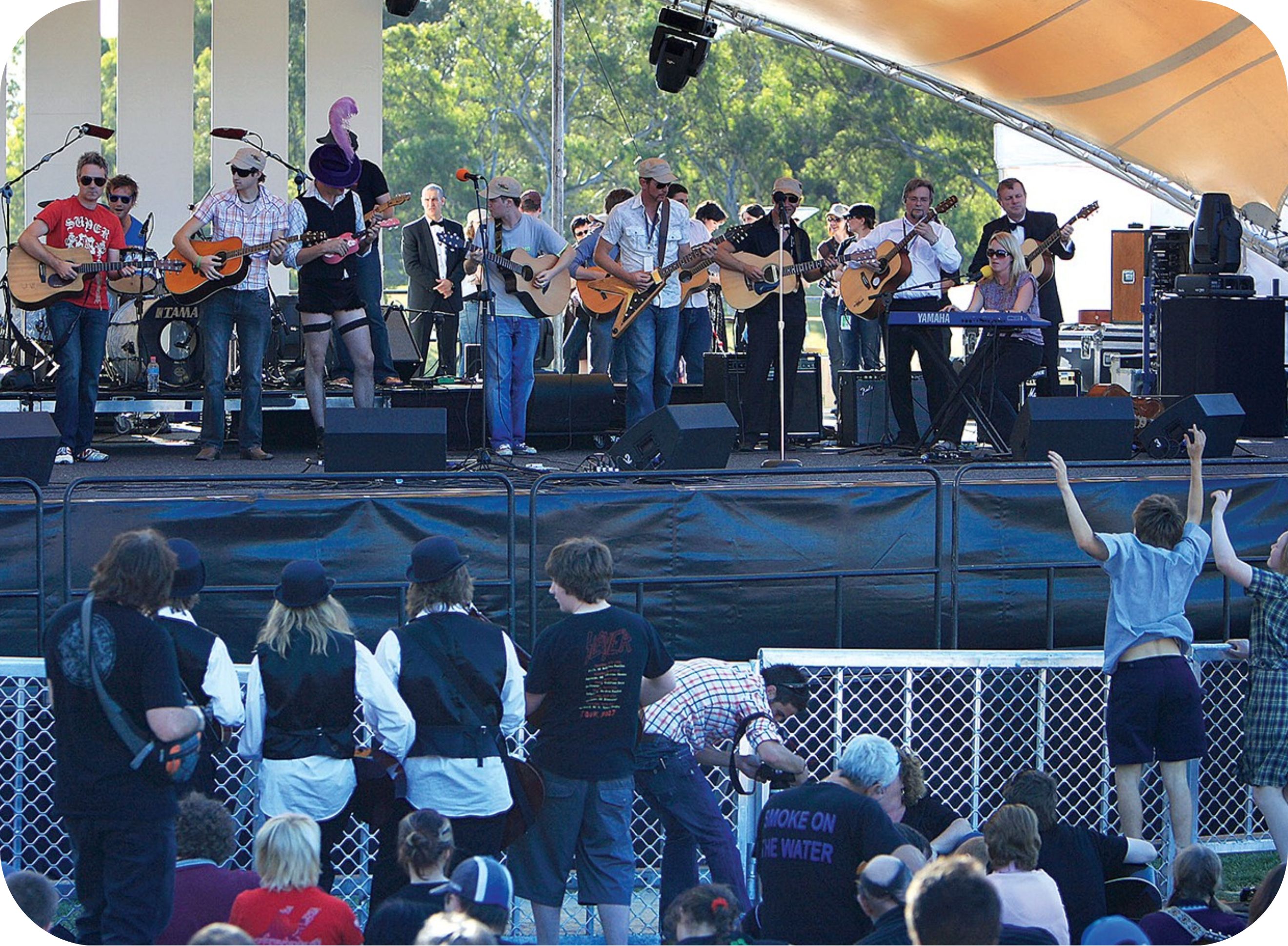 The idea for the Adelaide Guitar Festival sprung – like many good ideas – from a few beers at WOMADelaide.
"There was (former premier) Mike Rann, (arts identity and former Fringe chair) David Minear, (late tourism luminary) Bill Spurr and a guy who was running the New York Guitar Festival at the time," Gautier says.
"One thing I remember from the first one was the attempt to get into the Guinness Book of Records for the most people playing Smoke on the Water (pictured left).
"I was playing next to Mike Rann and he was playing the wrong chords! I leaned over to tell him and he grinned and said, ‘don’t worry about it, they’ll think it’s you!'. We both had a good laugh at that."
Gautier says the success of the Adelaide Guitar Festival really hinged on the man in charge, Director and acclaimed classical guitarist Slava Grigoryan.
"Adelaide Guitar Festival has been forged by Australian musicians, by South Australian musicians and, principally, by Slava," he says, adding that Grigoryan also played a key role in helping Adelaide win its bid to be listed as a UNESCO City of Music.
So what does retirement look like for someone who has rolled from one major project to another for his entire working life? Busy, unsurprisingly.
"Well I’m the Deputy Chancellor for Flinders University, and I’m going to continue in that capacity for the next couple of years," Gautier says.
"And I sit on the National Foundation for Australia China relations, which is the federal body looking at engagement between Australia, China, Taiwan and Hong Kong, and my part is really looking at arts and cultural engagement. And I sit on the Global Cultural District Network Board."
And his advice for young people hoping to make a career in the arts? Go for it.
"The arts are a very important part of a good community," Gautier says.
"The way art connects with health, the way it connects with tourism, the way it connects with city branding, the way it connects with multicultural communities and indigenous culture - it just has so much to offer."