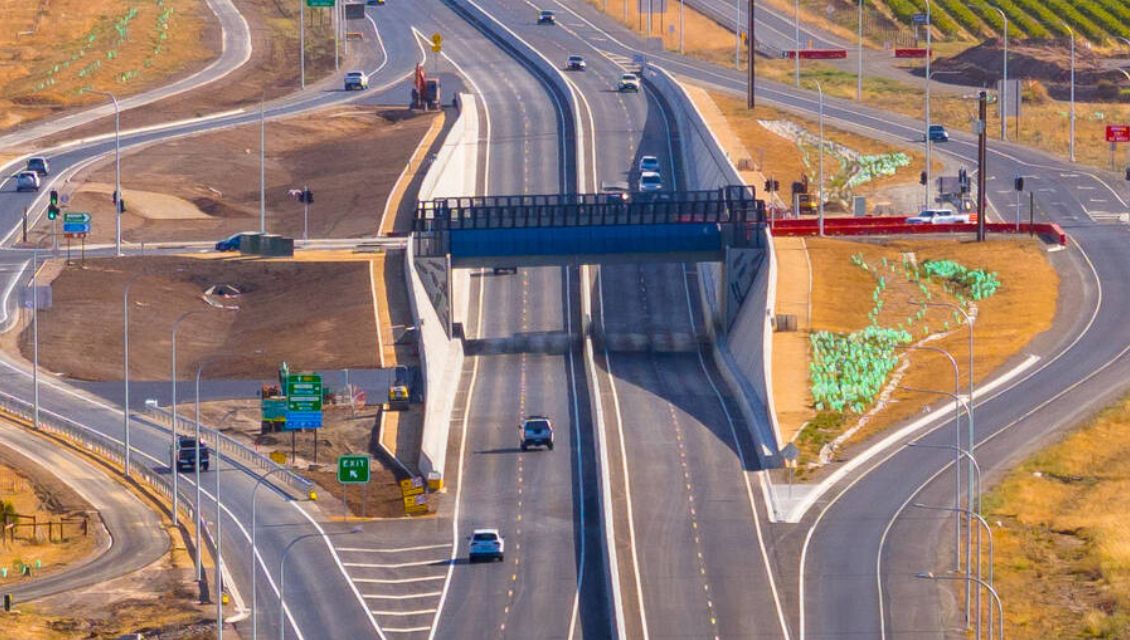
Thousands of South Australian motorists have already taken advantage of the duplication of Main South Road between Aldinga and Sellicks Beach after it opened to traffic last weekend.
The joint Federal and State Government project, set to improve travel times and safety for motorists heading to the Fleurieu Peninsula and beyond, includes a new interchange at Aldinga featuring a new underpass and improved crossings to Aldinga and Willunga, as well as the dual carriageway between Aldinga and Sellicks Beach.
The entire project is now complete, with Stage 2 of the Main South Road duplication being delivered as part of the $810.4 million Fleurieu Connections Project, with funding contributions of $221.6 million from the Australian Government and $588.8 million from the South Australian Government.
Main South Road is a critical link between Adelaide and the Fleurieu region and carries around 19,000 vehicles a day, with traffic volumes expected to grow to 26,000 vehicles a day by 2036.
Along with the duplication, the installation of wide centre medians and wire rope safety barriers to separate northbound and southbound traffic will improve safety and help prevent head-on crashes.
Other features of the project include two U-turn bays to facilitate local access, intersection upgrades at Hart and Colville roads, Norman and Rogers roads, and Hahn and Cox roads, as well as upgrades at Perth Street and a realigned Sellicks Beach Road that improves sight lines and safety.
The project also includes the construction of a shared-use path along the western side of Main South Road. This new path finishes a continuous, dedicated pedestrian and cyclist link from Seaford to Sellicks Beach, encouraging active transport and better connecting local communities.
Stage 2 supported 405 full-time-equivalent jobs over the construction period, with approximately 95 per cent of project contracts being awarded to South Australian businesses.
More than two million work hours were delivered by local people across planning, construction, traffic management, environmental services and support roles.
And in a link to the region's famous viticultural heritage, more than 9000 tonnes of glass – the equivalent of 43 million recycled glass bottles including wine bottles from the region – was repurposed in the construction of the roadway.
The focus on sustainability has also extended to the natural environment, with close to 100,000 native trees, shrubs and understory being planted along the corridor.
Speed restrictions will remain in place on the newly opened duplication and the underpass over the coming months as finishing works are completed. Please take care and observe signage.
MORE STORIES LIKE THIS