
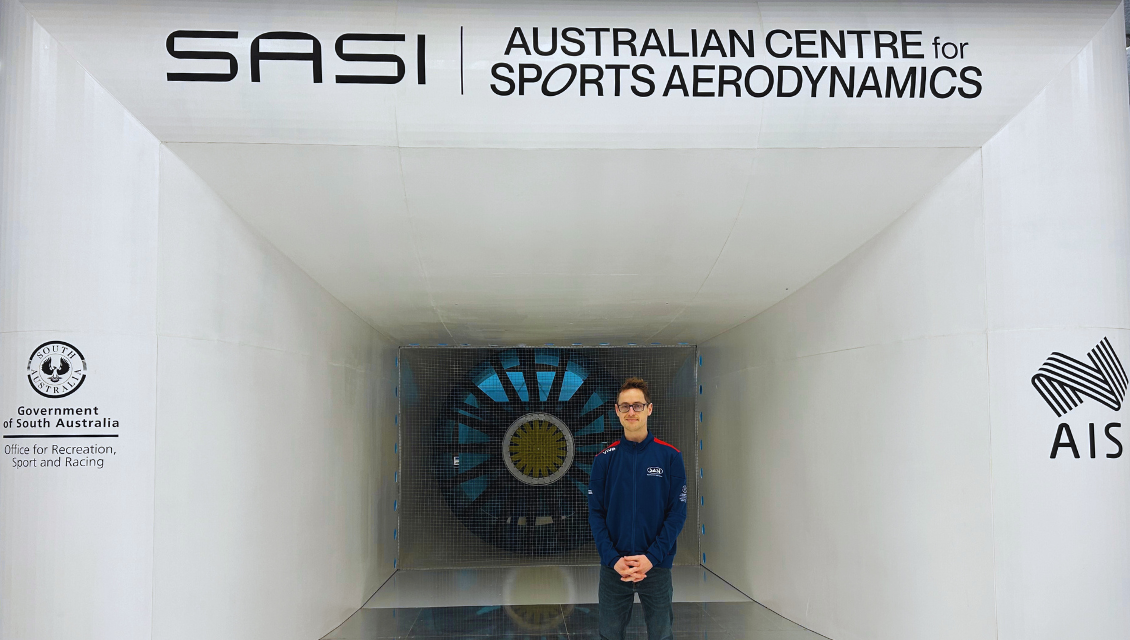
The recently opened Australian Centre for Sports Aerodynamics (ACSA) – home to a world-class wind tunnel – is helping give our Olympic and Paralympic hopefuls a competitive edge.
Able to replicate wind speeds of up to 110km/h, the facility can guide precision aerodynamic performance improvements in many sports, including cycling, snowboarding, athletics and rowing.
The state government contributed $12 million and the Australian Institute of Sport (AIS) $3 million to the structure, which is expected to attract national and international athletes to SA.
The ACSA is conveniently located alongside the SA Athletics Stadium, the new South Australian Sports Institute (SASI) and the soon to be redeveloped Netball SA Stadium, at Mile End.
Several Australian athletes set to compete in Paris have already been using the state-of-the-art tunnel, along with athletes preparing for the 2026 Winter Olympics in Italy.
The structure comprises a 4m-diameter fan that sits at the back of a large tunnel, drawing air through a big tub e that it then ejects around a test section and into an inlet that controls the flow.
A custom designed turntable (pictured right) balance measures the drag forces on athletes and equipment.
This allows wind resistance forces to be analysed, highlighting where changes can be made to athlete positions, clothing, event strategy and equipment to help gain a competitive advantage.
SASI Head of Aerodynamics John Pitman said early feedback to the wind tunnel, which was first pitched as an idea in 2015, had been “fantastic”.
“We had had really good feedback from the people who we have already had in, including some of the sports doing pre-Olympic testing,” Mr Pitman said.
“It’s made a few people faster for Paris.”
SASI Director Keren Faulkner was excited that SASI scholars and graduates had this state-of-the-art facility on their doorstep.
“The podium positions at an Olympic/Paralympic Games can often be determined by milliseconds so having access to train in a sports wind tunnel could be the difference between winning or missing out on a medal,” she said.
“The versatility of the wind tunnel is also key where the use of it can be modified to benefit both para and able-bodied athletes.”
AIS Performance Executive General Manager Matti Clements said: “The facility is a tangible example of how the Australian high performance sport system is united and working together to provide a world-leading environment for athletes to win well and achieve their full potential.”
The wind tunnel was designed and fabricated by AEROLAB at their headquarters in Maryland USA before being shipped to SA.
It can also be used by universities and industry to support education, sports innovation and research.
For more information, visit SASI.