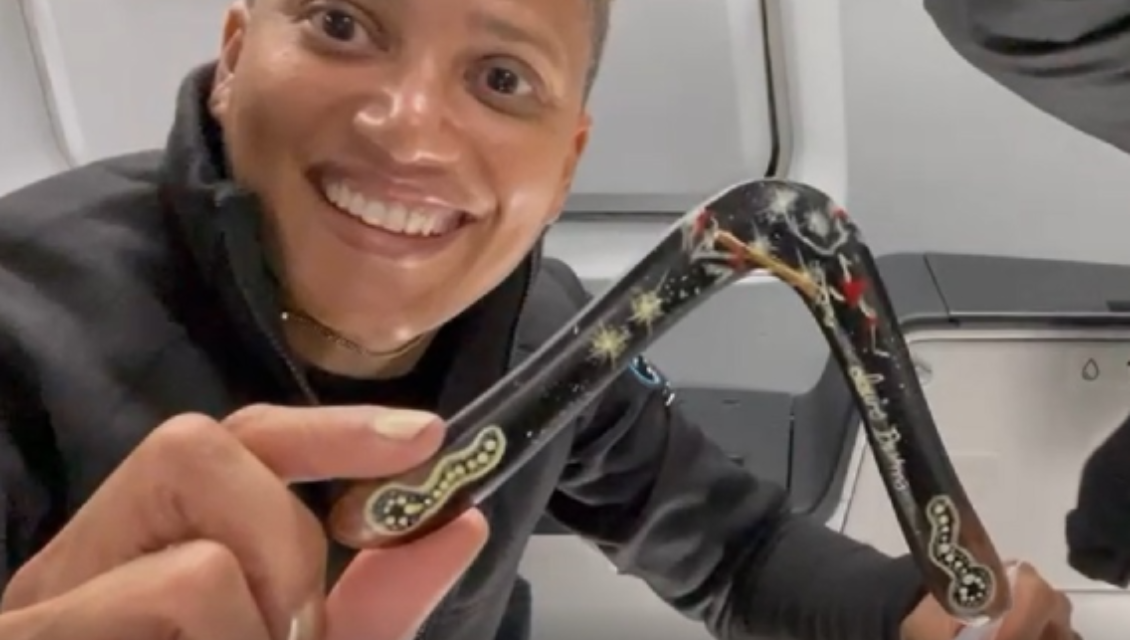
A boomerang that's been to space is now on display at the Australian Space Discovery Centre.
Created by renowned Indigenous artist and Talbragar-Wiradjuri man Lewis Burns, the boomerang's artwork reflects his depiction of “Dreamtime Corroboree” – an illustration of a spiritual bond between the people and the ecosystems on Earth.
It was carried into space by US astronaut Dr Sian Proctor onboard the 2021 SpaceX Inspiration4 mission – the first all civilian spaceflight to orbit Earth.
Langley Proctor - Dr Proctor's brother - said when he learnt his sister was going into space, he wanted her to take a boomerang from Australia.
"I want to thank Lewis for what he did, and what he created," Mr Proctor said.
"It's beautiful, I love it, and my sister was so happy about it having it travel the world 48 times in the three days they were in space."
Australian Space Agency’s space historian Kerry Dougherty OAM said: "Astronauts carrying small items into space that have personal or symbolic meaning is a tradition that goes right back to the beginning of human spaceflight."
South Australia’s own Andy Thomas carried several symbolic items on his first spaceflight, including a piece of Captain Cook’s ship Endeavour, a boomerang, and the pilot wings worn by Ross and Keith Smith, who carried out the first flight from England to Australia in 1919.
Dr Shannon Walker, an astronaut and Andy Thomas’ wife, also carried a boomerang created by Kaurna man Jack Buckskin, which was commissioned by the South Australian Museum as an expression of modern Aboriginal culture and ingenuity.
Yuri Gagarin, the person in space, carried a small doll that belonged to one of his daughters, which he used as a “zero gravity indicator”. When the doll floated free, Gagarin (who was strapped into his seat) knew that he was now in weightless conditions.
For more information visit the Australian Space Agency website.