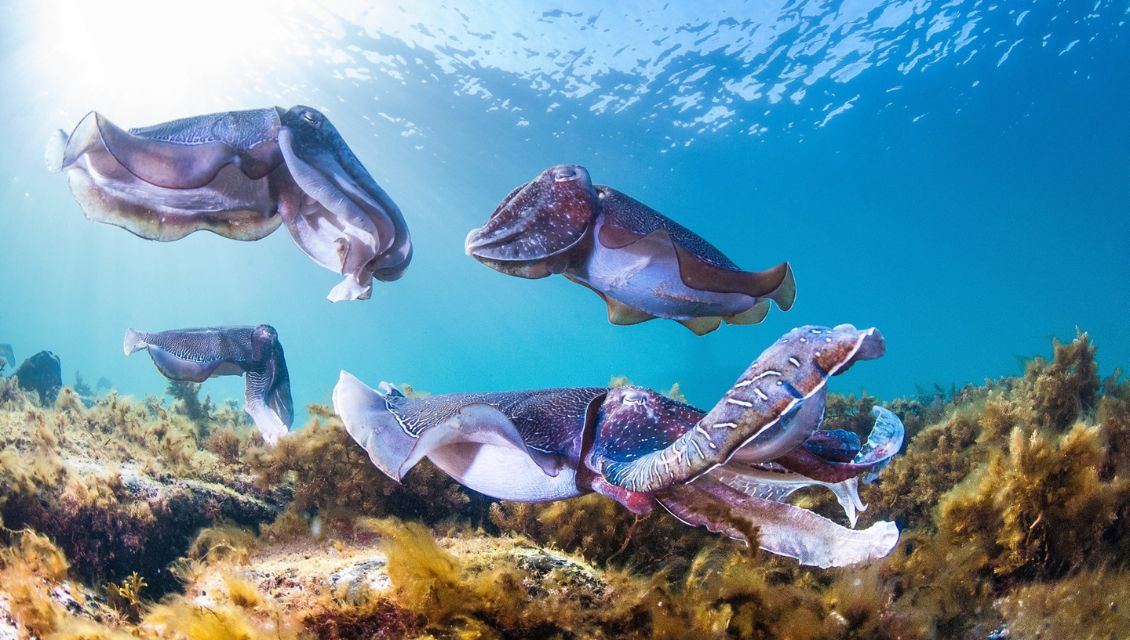
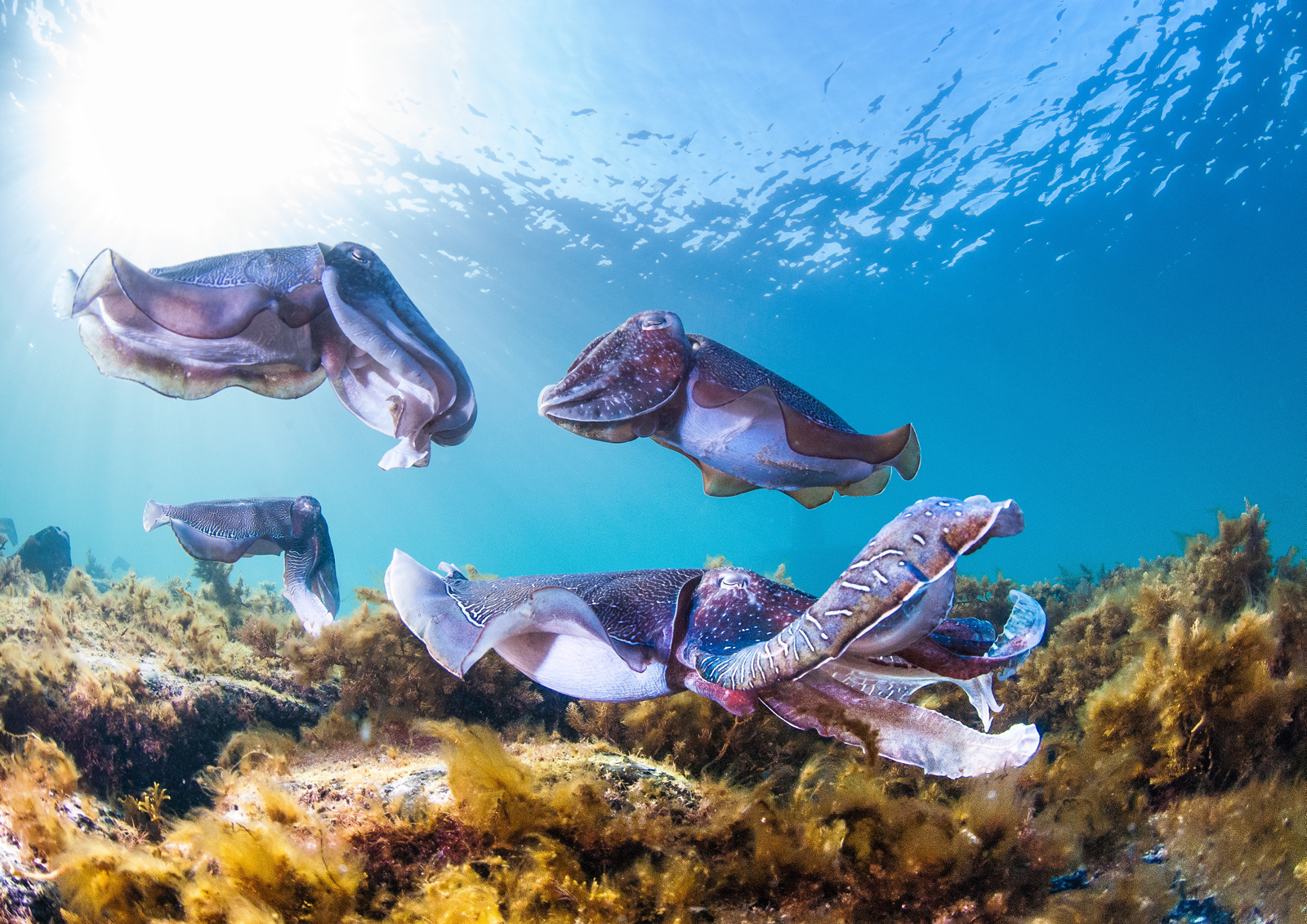
One of the world’s most incredible underwater tourism experiences – the spawning of the giant Australian cuttlefish in waters near Whyalla – has begun.
The gathering of thousands of the huge cephalopods, which can weigh up to 10kg, draws divers from around the world to the Iron Triangle town with many comparing it to some of the globe’s most iconic aquatic attractions.
The creatures, which can be found mainly in shallow waters around Stony Point, gather in the area to spawn.
Impressing and intimidating each other with flashing exhibitions of iridescent colour and displays of aggression, the animals remain largely oblivious of their human observers, allowing snorkellers to get up close and very personal.
Dive master and guide with Whyalla Diving Services Romy Pittoors said the first of this winter’s giant cuttlefish had begun to arrive.
“We’ve been seeing them at Black Point (about 3km west of the most popular viewing spot at Stony Point),” Ms Pittoors said.
“There have been around 50 or 60 cuttlefish there, and they’ve mainly been seen by scuba divers as they’re able to go a little deeper.”
Ms Pittoors said 2023 was an incredible year for giant cuttlefish, and everyone in Whyalla was hoping 2024 would be just as good.
She said people could check Whyalla Diving Services’ Facebook page, or call ahead, before planning a trip to check on numbers.
And Ms Pittoors said cuttlefish were not the only underwater attraction in the area.
“You might see dolphins, who come in and feed on the cuttlefish, and seals, along with wobbegongs and maybe Port Jackson sharks,” she said.
The South Australian Research and Development Institute (SARDI), the research arm of the Department of Primary Industries and Regions, has led the research into this iconic species in South Australia for more than two decades, tracking population trends.
Dr Mike Steer, Research Director, Aquatic and Livestock Sciences at SARDI says the research contributes to the sustainable management of Giant Australian Cuttlefish in South Australia.
SARDI established the methodology to survey the unique cuttlefish spawning aggregation in 1998 as part of its stock assessment program. The survey design has remained relatively unchanged and, with the exception of a few years, has been used to track the status of the spawning population for over two decades.
“The annual spawning aggregation of the Giant Australian Cuttlefish is an incredible spectacle of courtship, colour, and competition,” Dr Steer said.
Dr Steer said SARDI’s work has focused on assessing the annual abundance of the spawning population.
“Each year, SARDI estimates the abundance of Giant Australian Cuttlefish along a 10km stretch of rocky reef fringing the Port Bonython Peninsula. Importantly, SARDI estimates how many cuttlefish are in the area during the peak spawning season, an estimate of their collective ‘biomass’ or weight, the sex ratio of the population, and the average size of the males and females.
“Over time, we can compare how the population is changing. We’ve learnt it’s a highly responsive species. Populations can fluctuate year to year, falling to below 20,000 cuttlefish in 2013 and rebounding to record levels above 240,000 cuttlefish in 2020.
"Changes are likely driven by environmental conditions. These annual surveys are important as they are relied upon to inform sustainable management of this species now, and for future generations of South Australians and our visitors to enjoy too.”
HOW TO SEE THEM FOR YOURSELF
Stony Point, near Whyalla, is one of the most accessible and consistent places to view the giant Australian cuttlefish congregation.
There you’ll find easy access into and out of the water thanks to a boardwalk and a waist-high chain, and it’s also where the glass-bottomed boat tours leave from for those who don’t fancy immersing themselves in Spencer Gulf.
And speaking of immersion, the water is cold – getting down to 10 degrees later in the winter. You’ll need a good wetsuit, along with booties, gloves and hood, if you plan on snorkelling.
These – along with masks, snorkels and fins – can be hired at Whyalla Diving Services or from Adelaide dive shops.
There is a permanent cephalopod (squid, cuttlefish, octopus) fishing closure in the False Bay/Point Lowly spawning area. Cephalopods must not be taken from within the area at all times.
Learn more about the research and management of Giant Australian Cuttlefish in South Australia.