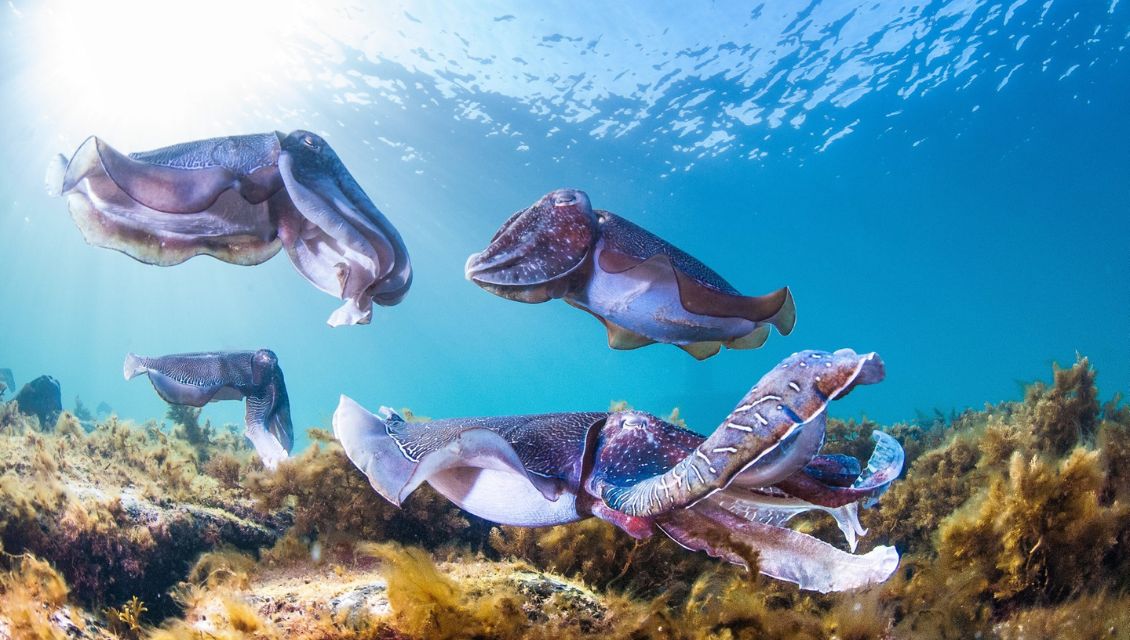
Marine scientists are counting giant Australian cuttlefish, and while it’s good news for now - with numbers looking healthy along the northern Spencer Gulf - the State Government says it will keep a close eye on the iconic species.
Scientists from the Department of Environment and Water (external site) (DEW) and the South Australian Research and Development Institute (external site) (SARDI) are currently finalising their surveys, but early indications have found large numbers of giant Australian cuttlefish, with the cephalopods still mating and laying eggs with no evidence of algal bloom impacts on the population.
A harmful algal bloom, currently occurring of the coast of South Australia, has resulted in the deaths of hundreds of species of fish and marine animals.
Government scientists met on 30 July to discuss management options if the bloom is detected in waters off Point Lowly, where the cuttlefish gather to breed, attracting divers and snorkellers from around the world.
The surveys, conducted on 29 and 30 July, occurred at 10 long-term monitoring sites established by SARDI.
This year, DEW has undertaken four counts at these locations, in May, June, early July and late July.
SARDI completed its annual counts at the same locations in June, and a full analysis of cuttlefish survey results will now be undertaken.
The surveys were undertaken as satellite imagery indicates elevated concentrations of chlorophyll-a in the region, a possible indicator of the presence of algae.
Water samples have been collected for testing to determine if algae is present and agencies are continuing to monitor the situation closely.
Dead adult cuttlefish are likely to wash ashore in the next few months, as they naturally aggregate to spawn and then die. This occurs every year and can be a good indication of spawning success.
The spawning population has exhibited significant fluctuations over the years, including a pronounced decline in the early 2010s followed by a marked recovery in recent years.
These trends are indicative of the species' short lifespan and its capacity to adapt to changing environmental conditions.
For latest updates on the algal bloom, click here (external site).
MORE STORIES LIKE THIS: