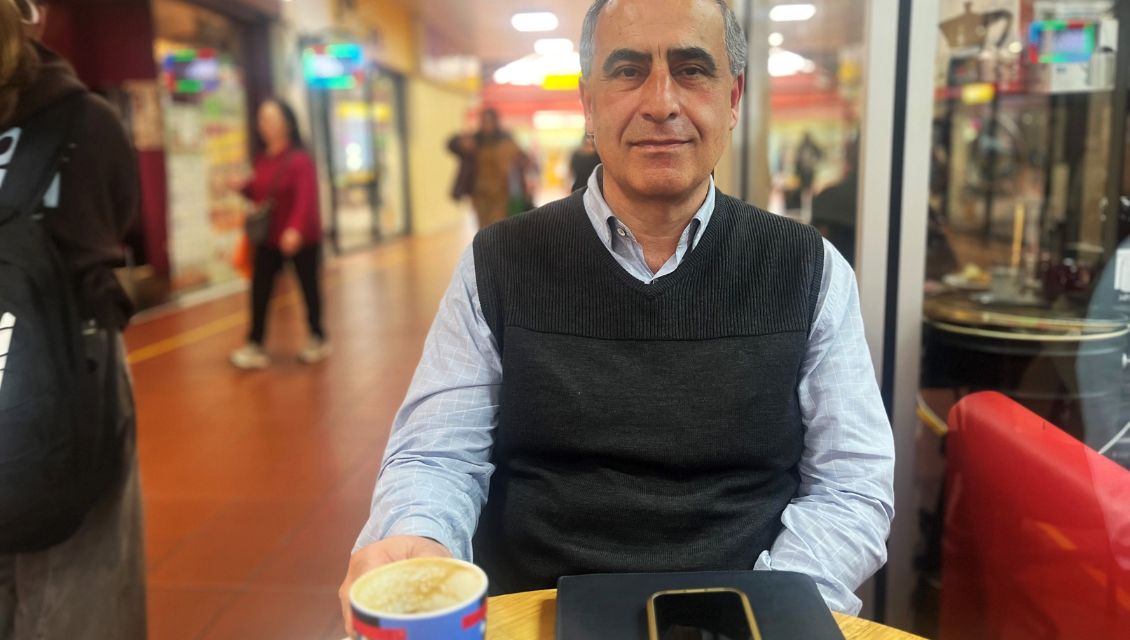
Mohammad "Amir" Amirghiasvand was, in his own words, born in Iran "a long, long time ago".
"It was 1963," he laughs as he enjoys a coffee at the Central Market cafe he's been frequenting since moving to Australia in 1994.
"I studied in Iran, but after the revolution that was not possible anymore because of my father's background.
"So, I went to India where I studied earth sciences and geology, and I did my PhD there."
While living in the subcontinent Amir added Hindi and Urdu to the Persian, Dari and English that he already spoke.
He's doesn't believe, though, that he has a particular knack for learning languages. For Amir, it was a matter of practicality.
"In India, for example, the academic language is English," he says.
"But if you want to survive, and you don't want to pay double the price for everything, then you have to be able to speak the language."
Moving to Australia
Amir worked as a geologist after immigrating to Australia, but found that the remote locations and long shifts away weren't ideal for a newly married man.
"When I married and my wife came to Australia - she was a chemical engineer - I realised that life as a geologist probably wasn't going to work for me," he says.
So in 1996 he transitioned to a new career as an interpreter, one he says is the direct opposite to life amongst the rocks.
"My job as a geologist was very repetitive and monotonous," he says.
"And one thing which you cannot say about interpreting is that it’s boring.
"It’s different every day - one job is medical, the next one is law, the next one might have to do with a loan. You learn a lot of stuff."
It's in complicated fields like the ones mentioned above where interpreters from the Interpreting an d Translating Centre are most in demand.
They're fields where decisions with lasting and serious impacts are made, and fields where the understanding of language is vital.
The intricacies of language
For Amir, the job is about much more than just knowing the languages involved.
"It takes a lot of skill to, for example, be able to remember things, to manage the dialogue," he says.
"For example, people have the natural urge to finish their sentences, and sometimes those sentences are simply too long.
"Or sometimes people will use a lot of jargon and assume that people have the same knowledge that they do."
And, he says, there are cultural quirks that extend beyond language that can have a crucial impact on how things are understood.
"You have to consider that a particular word may not even exist in another language, so it will take longer for the person to understand.
"And there are cultural differences. In the Middle East, for example, mostly people talk indirectly. They're not very direct. You have to break the news to them.
"And it may take longer to say the same thing, and this can be frustrating for people, especially in court."
But, Amir says, making sure everyone involved has an understanding of exactly what is being said is at the core of his role.
"As an interpreter, a lot of things we discuss are very serious," he says.
"When it comes to health, for example, it’s very important that the other party gets a good understanding of what’s happening so that they can either agree or disagree knowingly.
"If the police have arrested someone and you’re in the interview it’s very important that you let them know what their rights are."
Amir says people are often relieved when he arrives to interpret, but that this can be "a double-edged sword".
"Yes, it's comfort for them, but at the same time it they have to be aware that we are just there to interpret," he says.
"We are not their advisor, we are not their company. We are not taking sides. So you have to be professional."
The future of interpreting
For Amir, who received his qualifications through the National Accreditation Authority for Translators and Interpreters, the rise of artificial intelligence apps that can understand and interpret languages is a fascinating development, but he doesn't think they're taking his job in the near future.
"Right now, AI is very good in direct speech, scientific speech, academic speech," he says.
"But when it comes to street talking, or day to day things, it’s not as good. At this stage the machine doesn’t do, say, sarcasm or irony."
And he says he would still encourage all young people to learn another language at school.
"I think you learn a lot from learning another language," Amir says.
"It’s not only about communicating, it’s about sharing a culture."
To find out more about using, or working with, the Interpreting and Translating Centre go to translate.sa.gov.au (external site) (external site) (external site)