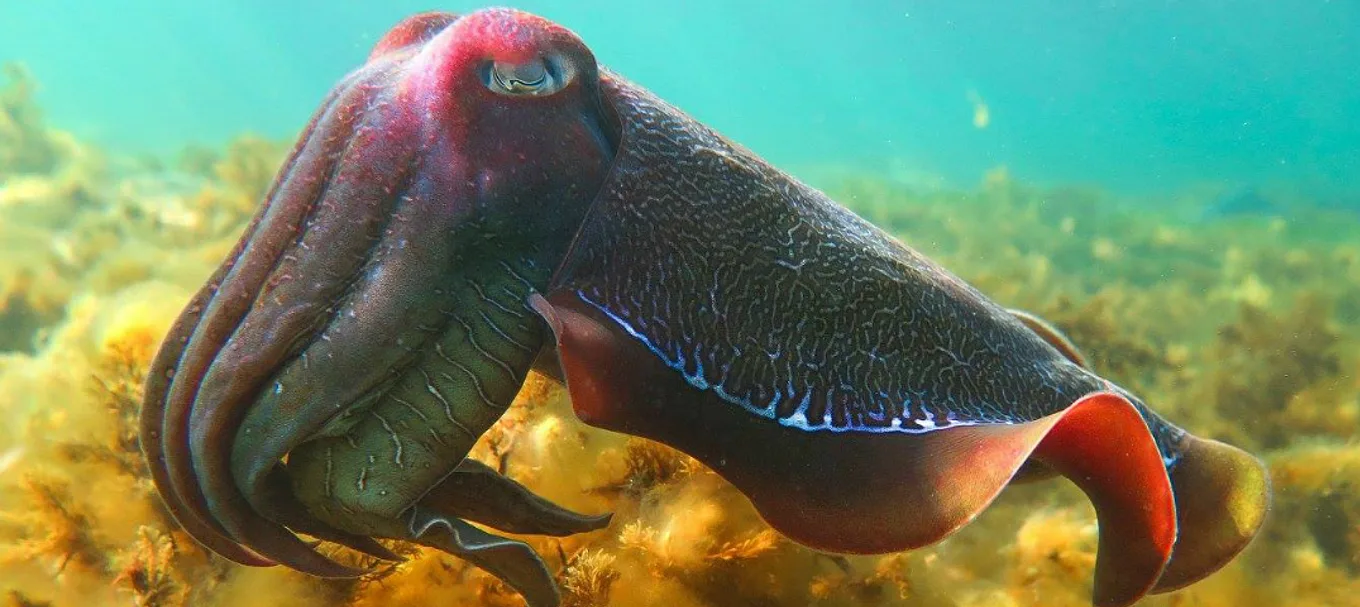
A giant air bubble curtain will be deployed in the Upper Spencer Gulf with the aim of protecting South Australia’s treasured giant cuttlefish population from the effects of algal bloom.
Funded by the state and federal governments, the 200m x 100m curtain will create a barrier of bubbles to protect about 50,000 to 80,000 cuttlefish eggs and hatchlings.
Air bubble curtain technology can mitigate the effects of algal blooms by disrupting the movement of algae, preventing it passing through the bubble curtain.
Land-based generators and compressors will be used to pump air through underwater feeder lines and tubing, creating a buffer zone between 2m and 7m deep along the rocky reef.
It will be the first time that air bubble curtains have been used in South Australia, and the installation will be animportant trial of this technology.
The method only works as a preventative barrier and is ineffective in areas where the algal bloom has already been detected.
While bubble curtains have been successfully trialled in WA to protect kelp from fish, there are limitations to where and when they can be used. They won’t, for example, protect oysters from brevetoxins, nor can they be deployed across vast areas or in intertidal zones.
Installation of the air bubble curtain at Point Lowly, by East West Dive and Salvage, is expected to be completed this weekend, weather permitting.
The algal bloom is present on the western side of Spencer Gulf and is moving north but has not arrived at Point Lowly. The air bubble curtain will only be operational if and when the bloom is detected nearby.
The Department for Environment and Water and SARDI will monitor the site in consultation with cuttlefish and algae experts to determine when the curtain needs to be operational. Cuttlefish season has closed for the year.
Marine parks and harbour restrictions will be enforced through a 50m perimeter around the curtain and the site will be monitored by cameras and surveillance.
Cuttlefish eggs will start to hatch in late October through November. Dead cuttlefish are anticipated to wash up on the coast at the completion of the spawning season in coming weeks. This is part of the natural cycle where cuttlefish die after spawning and should not be attributed to the algal bloom.
The latest giant cuttlefish counts show an estimated population at Cuttlefish Coast of 63,374, compared to 81,420 in 2024.
The lowest cuttlefish population estimate was approximately 13,500 in 2013. The highest population estimate on record is 247,146 in 2020.
PIRSA Executive Director Professor Mike Steer said: "The bubble curtain provides us with another tool to help protect unique and vulnerable marine species if required.
"By investing in science-based technologies such as this, we hope to protect those species we know could still be adversely impacted, particularly during egg development and hatching."