It’s one of the greatest stories of Australian exploration.
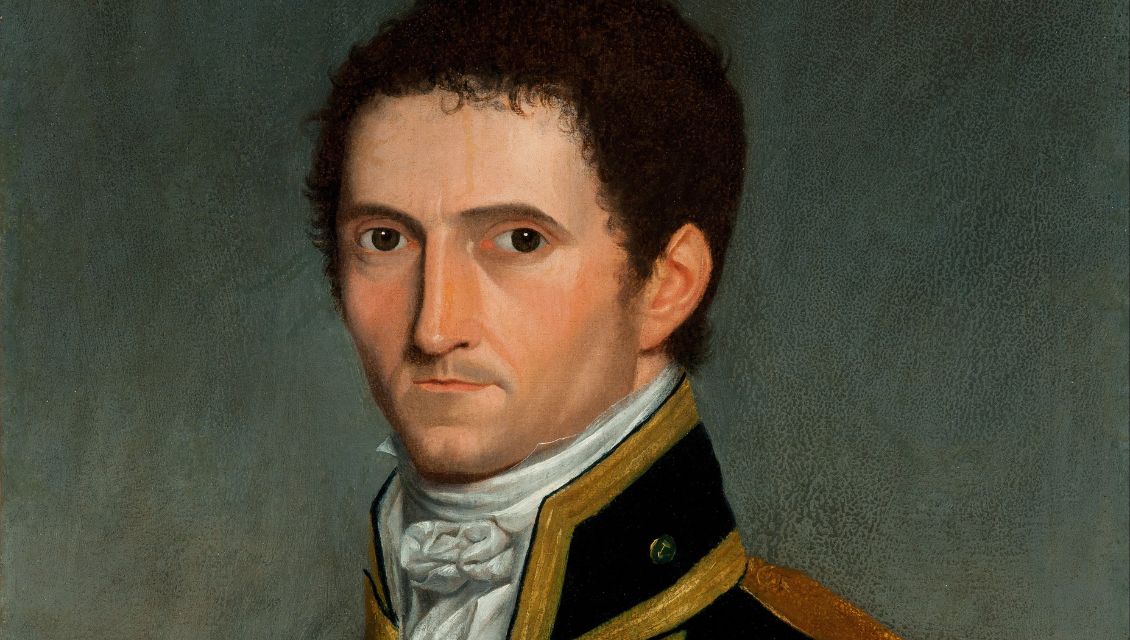
A young Royal Navy officer with a thirst for discovery embarks on several voyages off what was then known as New Holland, famously completing the first circumnavigation of the continent in 1803 and creating the first accurate maps of our coastline.
Among his many achievements Matthew Flinders proved Tasmania was an island and was one of the first people to use the term “Australia” on his maps, effectively naming our country.
And he did it all with a curious spirit – accompanied by his loyal cat Trim and his trusty flute – and with a heart that ached for his love Ann, the woman he married and didn’t see again for nine years.
His legacy in South Australia is unsurpassed. He named Port Lincoln, Spencer and St Vincent Gulfs, Kangaroo Island and Mt Lofty, among dozens of other locations and some of the charts he created remained in use until very recently.
With all of those achievements it would be logical to think that he returned to England a hero, but it was not to be.
Arrested and imprisoned by the French on the island of Mauritius for more than six y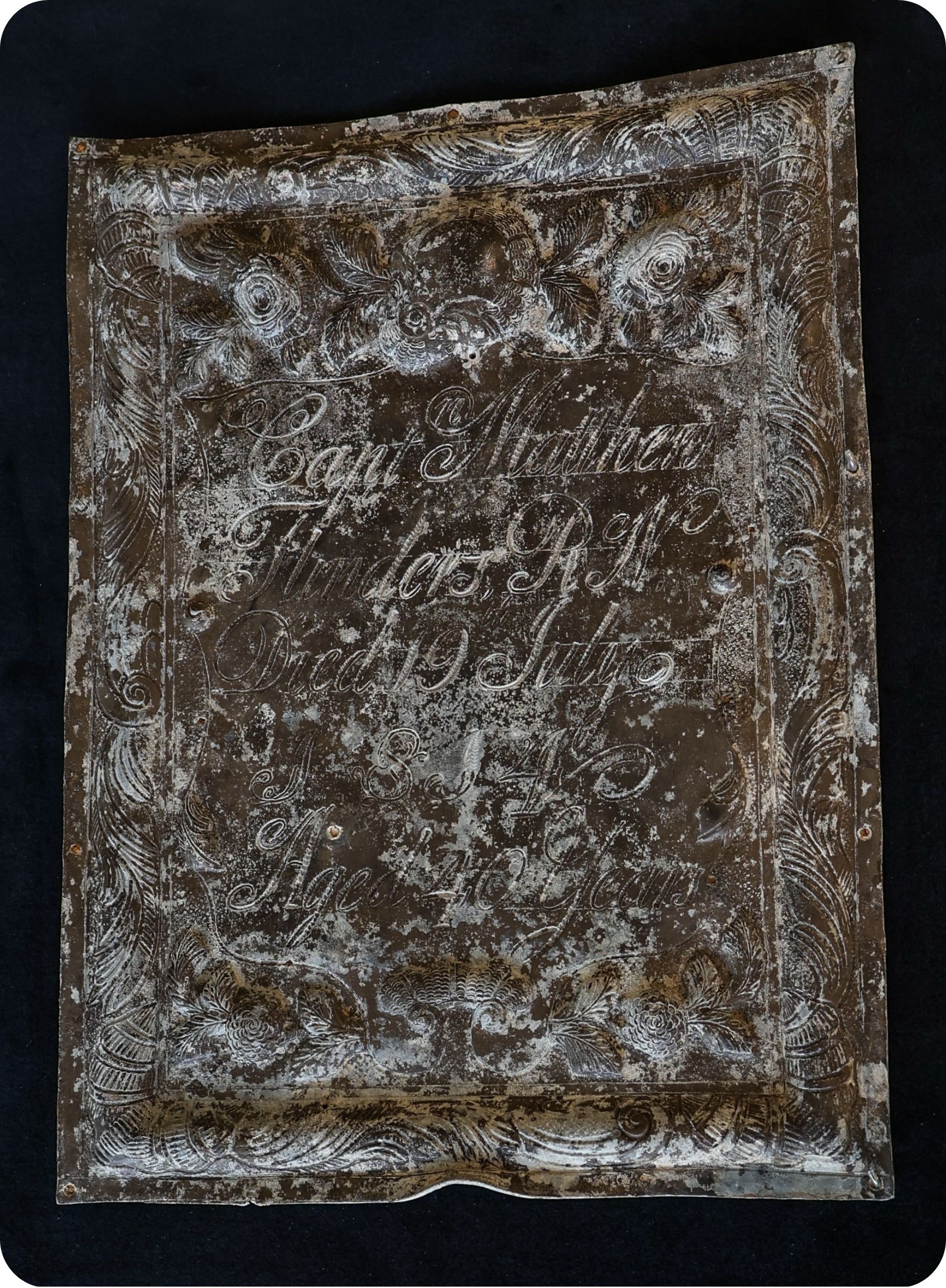 ears, Flinders was eventually released in 1810, but his health never fully recovered from his tropical incarceration and he died in 1814 aged just 40.
Buried in a London cemetery, the location of his grave had been lost by the 1850s and remained unknown until it was uncovered in 2019 by archaeologists brought in to assess the graves that were about to be covered by the expansion of Euston Railway Station.
But how did they know it was Matthew Flinders’ grave they had discovered? Well, it was all thanks to a remarkable preserved coffin breastplate attached to the outside of the explorer’s coffin.
Flinders’ bones were reburied at the Church of St Mary and the Holy Rood, in his hometown of Donnington in Lincolnshire, but the breastplate is now back in South Australia.
The breastplate was gifted to the Governor of South Australia, Frances Adamson AC, by Flinders’ descendants in recognition of his significant contribution to the state’s colonial history.
Upon acceptance of the plate on behalf of South Australia, it became part of the State History Collection under the care of the History Trust of South Australia, the statutory authority responsible for the research, collection and sharing of South Australia’s history.
After going on display as part of the recent Matthew Flinders: Fearless in Life, Love, and Tragedy, the precious breastplate is now at Artlab Australia, where vital preservation work is being carried out.
History Trust of South Australia senior curator Tony Kanellos says Flinders' legacy endures in Australia, where his name is linked to more than 200 topographical features and places, reflecting his extensive exploration, particularly along South Australia's coastline.
"Renowned for his intrepid spirit, cartographic innovations, scientific contributions, and care for his crew, he is inscribed in Australia’s colonial history as a figure of compassion, courage and ingenuity," Mr Kanellos says.
Jo Dawe, Principal Object Conservator at Artlab Australia (pictured), is in charge of ensuring the Flinders coffin plate remains stable after more than 200 years underground.
It is, she says, a case of preservation or conservation, not restoration.
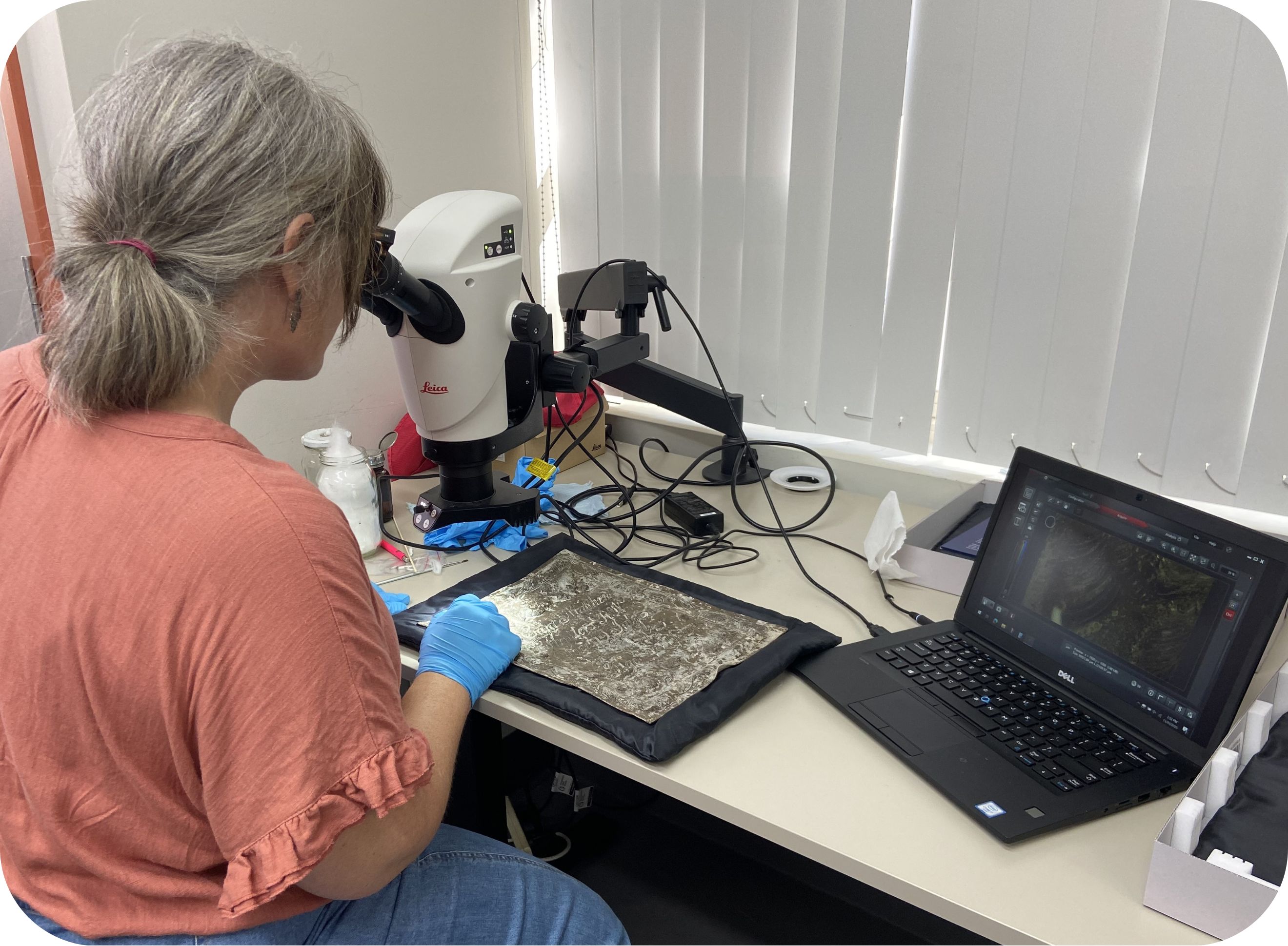 "When any item comes into Artlab we do an assessment and we document it," Ms Dawe says.
"So this has been photographed front and back, and we’ve used raking light so we can see the detail.
"From that we can formulate the best treatment in order for this to have the longest life possible."
Ms Dawe says that as the breastplate is an archaeological find, the aim is to keep as much of the original information as possible.
"We would never scrub something like this back and repaint it, for example," she says.
"Part of its glory is its obvious age."
Ms Dawe says an pXRF machine – portable X-ray fluorescence – was used to confirm that the breastplate was, as suspected, made of lead before a plan for its preservation was drawn up.
"Lead itself is a relatively stable metal, but it does respond and break down with exposure to certain acetic acid vapours, such as those given off by some woods,” Ms Dawe says, adding that this will have implications when it comes to creating a permanent case for the object.
"Our main objective is to stabilise and prolong the life of this breastplate, without altering its current archaeological appearance. We will continue to monitor the breastplate to check for the possible formation of (destructive) active corrosion that could jeopardise the longevity of this piece and distort the legibility and appearance of the surface detail."
For Ms Dawe, who says she was inspired to become a conservator after seeing the profession portrayed in a movie, working on an object as important as the Flinders breastplate is a privilege.
"The overriding rule in a museum or a gallery is that you can’t touch things, but as conservators we are really fortunate that we can look so closely at things – even under a microscope – and we can touch things," she says.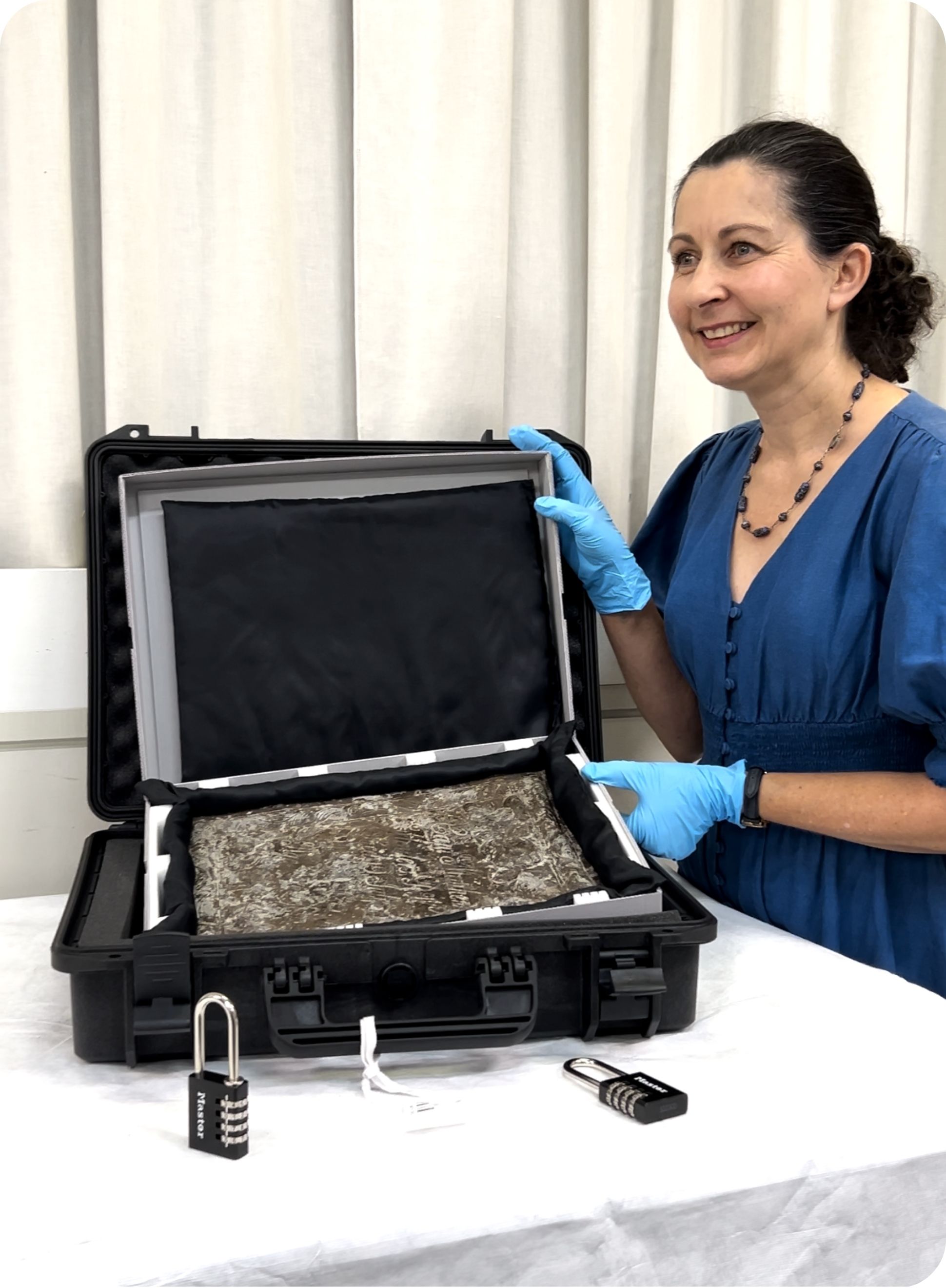
"That I can look so closely at objects like this, then use that information for a positive outcome for the object, is a privilege."
Artlab’s Senior Objects Conservator Sophie Parker (pictured) was charged with the task of making sure the coffin plate made its journey from England to Adelaide unscathed.
This involved creating a special case for the plate to be transported in, without actually seeing the object.
"We didn’t have a lot of lead time to plan for it, and we didn’t have a lot of information about the plate itself beyond its dimensions and its weight," Ms Parker says.
"And we knew we wanted it to be hand carried by whoever transported it and not put into the freight luggage.
"We were also constricted by the size it had to be in order to be carry-on luggage."
Chaperoned by the Governor’s assistant and safely packed in its specially created case, the breastplate made it to Australia unscathed.
"It turned out to be quite a sturdy object, but you never know because it had been buried for a long time," Ms Parker says.
She says she was surprised to see how pretty, and how much craftsmanship, had gone into the breastplate.
"You get a real sense of the person who crafted it," Ms Parker says.