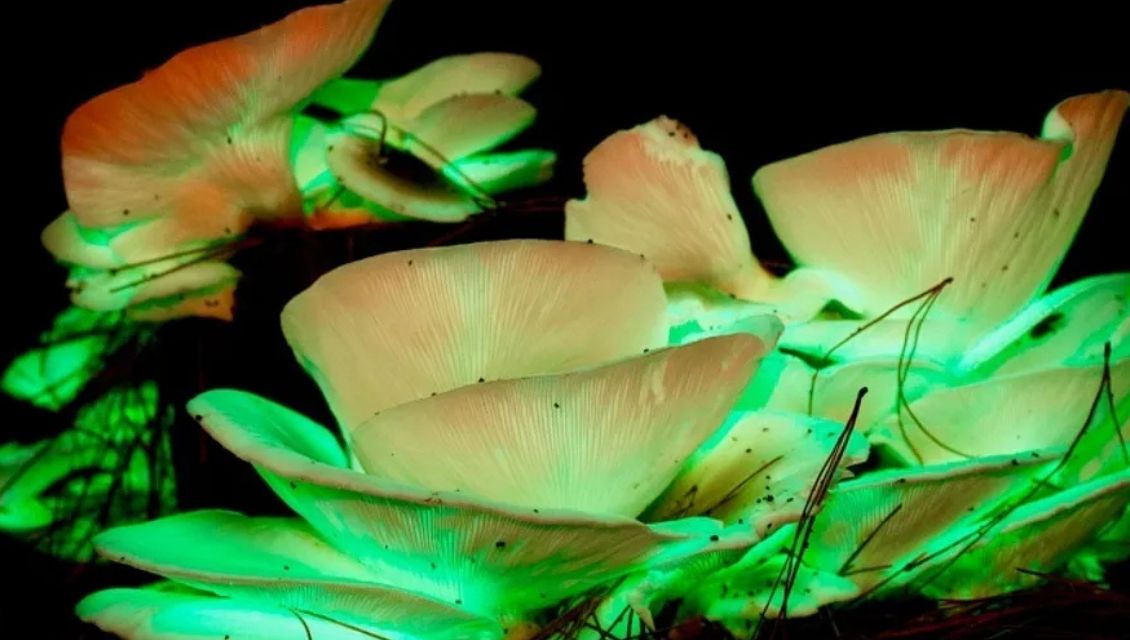
Ghost mushrooms get their name because they have an eerie glow.
The mushrooms’ cup-shaped fruiting bodies grow in clusters and sometimes bouquets on pine stumps, the base of living eucalypt trees or along old roots, and can grow as big as 20cm across.
In daylight, they appear a creamy white colour, sometimes with brown, black or purple shading, but at night we can see them glowing green.
Like glow worms, fire flies, and sea sparkle (external site), ghost mushrooms produce light known as bioluminescence through an internal chemical reaction.
Where to find them
The best place to find ghost mushrooms in South Australia is in Glencoe Forest near Mount Gambier.
Walk the Limestone Coast offers guided tours (external site) , taking you to the best spots to se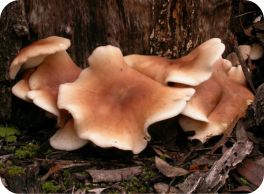 e these fascinating fungi.
You will have to be feeling a bit spontaneous, because due to the fragile nature of the mushrooms tour dates are only released a few days in advance.
After wet weather, you may be lucky enough to find these amazing fungi in other parts of SA as well, typically near the base of the trunk or in crevices of native eucalypt species, but especially where there are pine trees.
Over the past few years, they have been seen in the Adelaide Hills, including in Para Wirra Conservation Park (external site) and Scott Creek Conservation Park (external site), as well as Padthaway Conservation Park (external site) in the South East and even on Eyre Peninsula, so keep an eye out next time you’re on a walk.
For recent sightings, you can visit iNaturalist (external site) – you may even like to put your citizen science hat on and record sightings for yourself.
Keep yourself safe around mushrooms
Ghost mushrooms are for looking at, not eating. Like many wild fungi, they are poisonous and consuming them can make you very ill.
Visit SA Heath (external site) for more information about staying safe around wild mushrooms.
Want to learn more about fungi? Try this post on 10 types (external site) you might see in the Adelaide Hills.
Main image courtesy of Ockert le Roux. This article was prepared by the Department for Environment and Water and has been reproduced with permission.